Showing posts with label Japan. Show all posts

Tuesday, 6 November 2012

Water and wisteria

Since discovering hanakotoba (Japanese language of flowers), I've been curious about what the significance of wisteria is in Japan. It was in bloom growing wild in the mountains when I visited Nara and Kyoto, and was the token flower of a shinto shrine I visited. I'd never seen it growing wild before, and it took my breath away! Every now and then you'd see a tree draped in purple among all the green in the steep sided forests where the vine had climbed through all the branches. Unfortunately we drove past all this too quickly for me to manage to get a decent photo, but here are some shots I got from the shrine!.

A shrine maiden with wisteria hair ornament. The hexagonal box says  omikuji, which  is a kind of Japanese fortune telling


Wisteria and brass (I think?) lanterns hung on the shrine building. The lanterns were everywhere, as if the shrine was a glorified Christmas tree, and they were all different, some broken and tarnished, others bright gold and brand new. It must look incredible when they are all lit.


Anyway, I just found this website talking about the symbolism of wisteria:
http://www.whats-your-sign.com/wisteria-meaning.html

It's really interesting. The site talks about the Japanese story of a wisteria maiden, a lady holding a branch of wisteria in a painting who falls in love with a man. She becomes so besotted that she steps out of the painting to capture his heart, but her attempts are futile and her love remains unrequited. Rejected, she steps back into the lonely world of the painting with her wisteria. The symbolism here not only talks about lost love, but the endurance of the heart in the face of rejection as well, as the weeping blossoms bloom from an incredibly durable vine. It strikes a chord with me, as I strongly believe that no matter how impossible or hard things are, there is always hope while you believe in it. This is true of art, tradition and culture too. However irrelevant or lost they may seem to have become, if one person finds something meaningful in them, then they will endure. This can clearly be seen in the case of Egyptian hieroglyphs, a written language lost and indecipherable until the finding of the Rosetta stone thousands of years later.

There are other meanings to wisteria too:

  • "Honor
  • Memory
  • Patience
  • Endurance
  • Longevity
  • Exploration
  • Creative expansion
  • Releasing burdens
  • The duality of love
  • Victory over hardship"
"Shin Buddhism also views the wisteria meaning is as a symbol of prayer, or thoughtful reverence for the same reason. The branches and blossoms seem to lower their head in gentle supplication. These vine gestures naturally bring to mind our need for peace, quiet, and time to honor the divine essence (of our own understanding)."

This fits in with the meditative qualities of tea drinking and the tea ceremony - exactly the ideas I want to convey with my pieces.

"Flora records indicate wisteria has been known to live up to 100 years or more, and so here it picks up its symbolism of longevity and immortality. European families mark the ages of generations passing with the growth of this vine, and so it makes sense the vine embodies an essence of immortality (as fathers and grandfathers tell their sons of stolen kisses beneath the same wisteria that grew during the day of their great grandfathers)."

This suits the idea of tradition, a thing that endures and stays the same through the ages. I also like things that speak of the past yet continue to maintain a thing of the present. That is the wonderful thing about Japan, the modern and the ancient exist and carry on side by side, alive and full of vitality. Most old things in England are in decline, being replaced or have become museums.

"Most interestingly, is the wisteria pattern of growth. Like most vines (and ivys), wisteria expansive tendrils grow out in a spiraling motion. The meaning of spirals deal with expansion of consciousness. Spirals also point to our awareness as the inner-most center. This awareness spans outward in a spiraling motion to indicate our influence on the outside world. In this manner, vines and ivys also remind us of our interconnectedness with everything on every level."

Meditation and reflection. Also, spirals represent creative energy, and tend to creep into my work when left to myself, so I think they are a reflection of me and my thought processes on quite a deep level. I like the flow and movement of them, and the energy that suggests.

Which leads me on to: water and flow.

A woodblock print of the whirlpool at Naruto in Japan - I have a copy of this pinned to my kitchen door in  the form of a calendar page! The energy and lines are really expressive.
The same whirlpool today!
Naruto against it's modern backdrop. The power and movement the deep texture of the water suggests is captivating. I'd love to see this one day, it's such an incredible and mysterious force of nature, and it doesn't seem to eat tourist boats alive contrary to stereotypes :)

Water and flowing movement are a huge part of working with clay, yet I have barely scratched the surface when exploring them. They are also a major part of the general backdrop of Japan - Japan is a collection of islands that relies on the sea after all. The general feeling I got from Japanese ceramics was that it always worked with the flow and nature of clay to achieve it's shape and beauty. It never fought it in an obsessive fight for perfection and a ridiculous level of extravagance, desperate to push the "boundaries" like so much Western ceramics seems to, and like I felt I do looking at all that amazing work. I felt stupid and pretentious.

SO

Continuing what I started in Japan, I am now starting to experiment much more with really thick liquid clay, finger marks and textures, inspired by the movement of water, wind, and clay on the wheel. I'm creating bowls in moulds by gunking the slip in, spreading it around, dragging my fingers through, and pulling up spikes or throwing droplets into the surface. I'm also throwing bowls, teapots and flasks and allowing the motion of the wheel to pull thick slip off my fingers onto the surface of the clay in spirals and amazing textures. It's actually amazingly releasing and relaxing working in this way, the act of making feels more meditative and I feel more creative. It has a similar feel to hakeme, except that uses a rice straw brush instead, but the contemplation, and then the simple sweeping strokes are just the same. I love the effects - they are much bolder and clearer than my previous techniques achieved. Photos soon!

Friday, 24 February 2012

Ken Matsuzaki

Just a quick post as I'm not feeling so good, but saw this when I was checking my facebook messages and the combination of glaze and pattern caught my eye. This huge platter is apparently in the region of 76 to 96cm AFTER firing! That takes an insane amount of skill. If I get the chance I'd love to see the exhibition.


Ken Matsuzaki
松崎健大皿展
直径76cm〜96cmまでの大皿30枚だけの個展
30枚それぞれが世界をもっています。
東日本大震災復興支援特別企画展
宇都宮 青木ギャラリー
☎028-639-0307 "


It you happen to be able to be in Utsunomiya-shi, Tochigi-ken, Japan in time for this exhibition.....check out some fantastic huge platters from a great ceramist. (And some proceeds of salesare going to the reflief efforts too.)"


I took a look at Matsuzaki san's facebook page after reading John's message and found a couple more pictures - a platter before firing:


Matsuzashi sans shard pile - apparently half of these are pots damaged by the big earthquake. I saw another potter's shard pile while in Tokyo, and they're actually very beautiful with the mix of dead leaves, twigs, and shimmering glazes all over the floor. In this setting it no longer matters that the pots are broken, they take on a new life and meaning of their own as artificial stones and rocks:


Shards of oribe glazed ware among the leaves at Shigemasa Higashida san's studio in Tokyo when I visited:

Thursday, 16 February 2012

Plane tickets and visas

It's finally sorted, I've bought the plane tickets to Japan! I'm definitely going for work experience in Tokoname. 
:D :D :D

As Tokoname is near Nagoya airport, I'll be flying from Birmingham via Frankfurt to keep the airport taxes down (London and Narita are not cheap!) and the prices Lufthansa are offering right now are actually pretty good, about half what I'd reckon was an average fare to Japan. If I'm lucky, I'll be just in time to see the sakura bloom and join in with the traditional hanami - the Japanese cherry blossom viewing parties.


All that is left now is the issue of visas. For the period of time I will be there (about two months), and considering I'm not being employed as such, whether I need a visa is, according to the Japanese embassy in London, a grey area. If I have no visa, I can't accept payment or monetary support from what I gather, so if I have the opportunity to sell work I make out there, I can't take it. Since they seemed so unsure of themselves, I'm going to apply for a working holiday visa. At £22, it's well worth it if it gives me freedom and peace of mind to enjoy my stay in the country. It's for people aged 18 - 30 who intend primarily to holiday in Japan, but want to earn some money to support themselves while they are there, and is valid for up to twelve months. All I have to do is download the form off their website, provide a CV and a statement of what I intend to do in Japan, and show a few other documents like my passport at an interview at the Japanese embassy in London. According to the guy I spoke to on the phone, it then takes about a week to process the application, and then they can post it to you. For anyone interested in visas for Japan, the website is:

http://www.uk.emb-japan.go.jp/en/visa/work_hol.html

I'd better get writing!


Monday, 13 February 2012

Ink, Print and Chrysanthemums

I bought a bunch of chrysanthemums, carnations and different daisies to study and draw from, and ultimately visually play with on paper :)


I decided I wanted to inject my own ideas and style into what I was looking at rather than just record what I was seeing, and these are the results so far (incredibly, the flowers haven't shown much sign of dying so far - even after a couple of weeks there are still some opening up!)

With my teapots I've been trying to layer up imagery and print on the surface, so I tried playing around and masking off the outline of a cherry blossom with masking tape. Then I used brown ink to paint the chrysanthemums, sumi-e style! The brown is a bit more subtle than using black, and tones nicely with the brown paper. Having got this far, I decided the detailed drawing on it's own wouldn't be enough to allow the sakura outline to be clear and stand out, so I roughly brushed some translucent iridescent blue white ink over the flowers, and finished by tinting the flower centres with coloured chalk dust.

Then came the tricky bit - taking the tape off again.....


I really like how the two of these images came out, but I actually really like the piece before I removed the tape. It looks like the next experiment is going to involve cutting and sticking coloured paper flower patterns to make a sketching/painting surface! I really like the way the imagery overlapped and glowed through one another. I should be able to translate this onto the teapots using coloured clay, slip trailing and screen print all layered up. I think just a small area of imagery like that (created with some nice earthy oxides or something subtle) could be really understated but really elegant too. It'd be too much if it covered the whole piece though.


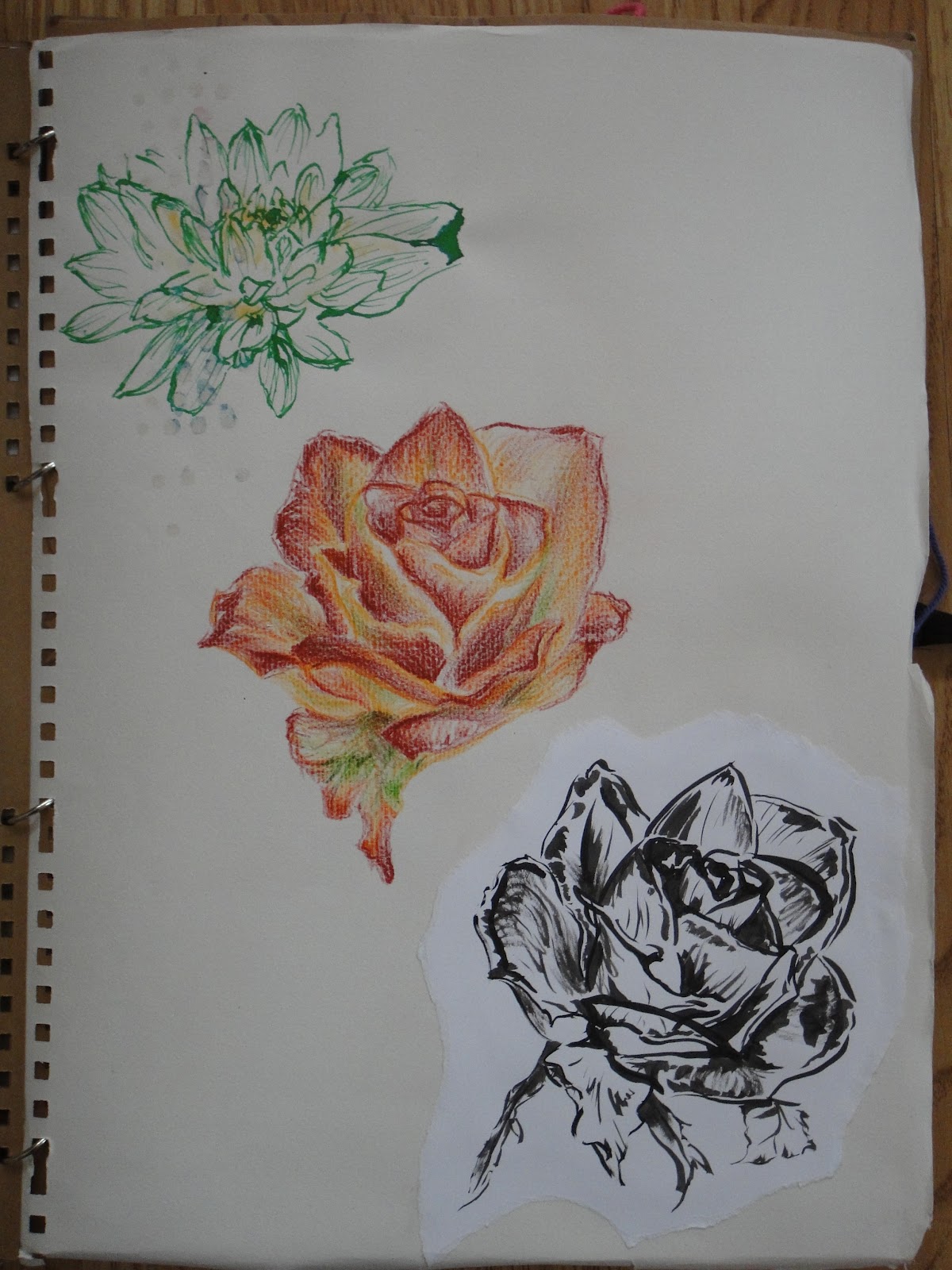
Here are the rest of the pages so far.

From the top: - Print with dip pen sketched chrysanthemum tinted with chalk dust, the first layered imagery test
- Roughly sketched rose in dry watercolour crayon, basically a quick exploration of colour
- Sumi-e rose in black ink, exploring shape, line and shadow.

For anyone interested, the Japanese name for rose is bara. The anime Saiunkoku monogatari has a really interesting fairytale it mentioned about the "rose princess" (bara hime). I don't know if this was just made up for the plot line, but it talked about why roses had thorns. Basically, the rose princess was a bit more than mortal, and very beautiful, with the gift of being able to cure any ill. Then she fell in love with a human man, so lost her power and died, becoming a rose and growing thorns so no other man could pick her.


Brush and brown ink chrysanthemums tinted with yellow, green and white chalk dust. I was trying to understand the form and shape, how they grew, and capture the spirit of the flower.


As before with a daisy and different kind of chrysanthemum (I think). I took adding colour to the brush drawings a bit further here, using watercolour to create rough shading and tints. I also put the print next to the drawings as a contrast to the layers.


More chrysanthemums - I'll probably work more into this drawing later


The other kind of chrysanthemum, this time with black ink and coloured print. I'm not so impressed with the starkness of the black compared to the brown ink, but I like the effect where the brush was starting to go dry - this is also what wabi sabi is for the Japanese. For some reason the fading nature of the ink reserve running out gives drawings a transient feel and beauty.


Iridescent print, with watercolour crayon and clear embossing liner daisies. I was trying to get a similar effect to slip trailing here with the raised outline, and then contrast it with coloured outlines.


The Golden Tearoom, built by Toyotomi Hideyoshi
Another embossing liner drawing, this time in gold. I'm considering using gold lustre to highlight certain bits of imagery on my teapots, as the Japanese often use it to highlight their designs to great effect on everything from washi paper to architecture. Although saying that, I think they went too far with their golden tearoom. I'll probably work into this drawing some more as well - I was wondering how it would look with the patterns from computer circuitry behind it.
Wooden carving of a dragon with added gold accents on the
bottom of a huge paper latern


Anyway, why chrysanthemums and daisies?

 The chrysanthemum is the official national flower of Japan (cherry blossom or sakura being the incredibly popular unofficial one), and in Japanese floriography (flower language) they mean happiness and long life, and are sometimes seen as an object for meditation. The daisies and chrysanthemums are very frequently seen in Japanese imagery and patterns, including everything from kimono to mon, Japanese family crests. According to wikipedia:

" Japan

  • The Chrysanthemum Throne is the name given to the position of Japanese emperor.
  • Chrysanthemum crest (菊花紋章, kikukamonshō or kikkamonshō) is a general term for a mon of chrysanthemum blossom design; there are more than 150 different patterns. The Imperial Seal of Japan is a particularly notable one; it is used by members of the Japanese Imperial family. There are also a number of formerly state-endowed shrines (官国弊社, kankokuheisha) which have adopted a chrysanthemum crest, most notably Tokyo's Yasukuni Shrine.[15]
  • The Supreme Order of the Chrysanthemum is a Japanese honor awarded by the emperor.
  • The city of NihonmatsuJapan hosts the "Nihonmatsu Chrysanthemum Dolls Exhibition" every autumn in historical ruin of Nihonmatsu Castle.[16]
  • In Imperial Japan, small arms were required to be stamped with the Imperial Chrysanthemum as they were considered the personal property of the Emperor.
  • The Chrysanthemum is also considered to be the seasonal flower of September. "


Tuesday, 7 February 2012

Red Fuji


I guess this is why "the land of the rising sun" has a red flag, and I start to understand why red is such a symbolic colour for them. This is such a powerful image of Mount Fuji! Even though it's sunset not sunrise.

What with the autumn Japanese maple leaves as well, red seems to have strongly associated itself with transition and changing states in this country.

Katana - Japanese swords


I love katana, but I have probably watched too many ninja and samurai movies! I've watched documentaries and read articles out of curiosity, and gained a great respect for the workmanship and skill in wielding and making them. Every stage is thought out and given every attention, from smelting the black iron sand with oak wood and sorting the pieces into soft and hard, to polishing the blade. 


The resulting sword is then so light and sharp it can slice through bullets and ice! Unlike European broadswords, they rely on skill and speed instead of brute force to be successfully wielded. Aside from that, I also love the fighting style that goes with the blades, and the long sweeping curve along the length of the sword which trace dance like patterns through the air when it is swung. I use similar curves and length in my teapot handles


This is the latest teapot I've been working on. It's another square bodied piece, working on the size and capacity from my previous one, and developing the imagery on the side. I've added screen print under the slip trailing to imitate the effects you get in modern Japanese printed media, especially manga, and this time I did a peony, plum blossoms and pine as it's winter right now ^.^
I'm not yet sure that the pine comes out too well yet though, I'm going to wait until I've glazed the piece to see whether the needles make it too busy for the imagery to be clear and stand out. This is the tallest handle I've created to date, and I'm a bit concerned about how much it will warp in the kiln. I'm hoping to use a new firing program to limit how much it will move in the kiln - I will hold it at top temperature for maybe only three minutes, and soak it for a long period of time at a lower temperature to allow the glaze to develop properly, so that nothing will be liquid/hot enough to run for very long. Anyway, you can see the height and gentle curve of the arching handle here, which has developed over time kind of subconsciously. It's a reaction to many things, Mel Brown's teapots (shown on the right), Japanese architecture and blades, and the way I naturally interact with the clay - I generally pull long lengths of clay before I'm happy with the shape and thickness down the length.

Monday, 30 January 2012

Tokoname, virtual teapots, and writing in Japanese


Hello again!

A fair bit has happened over the past few days, so I'll try and start at the beginning.

Well, I've been busy trying to investigate new teapot designs and decoration since I came back from Japan in October (but more about that in a later post). There was so much amazing stuff out there, and I spent two weeks surrounded by ceramic artists from all over the world, so I've gone on a bit of a tangent since I returned so that I can try out all the things I saw. One of the things that stuck in my mind the most was watching Magdalene Odundo work. I learnt about her in my first year of university when we were taught about smoke firing and burnishing pots, and it always struck me that despite using the coiling method, her pots always looked perfectly symmetrical and round, as if they'd been cast or something. When I actually saw her working, it was nothing like that!!! Her clay was just as rough surfaced and lumpy as everyone elses. What she does, is smooth and shape the surface once the pot has stiffened by paddling it with a piece of wood, before she finishes by polishing the piece with tumbled pebbles.
Magdalene Odundo making a coil pot at the ISCAEE conference at Tokyo Gedai University


She uses this paddling method a lot. While we were doing a group project out there, she showed our group how if you made an enclosed bubble, you could then pat it into shape to your hearts content, knowing the air pressure inside would stop the pot collapsing. Chris Archer (lecturer at an American University) was doing this too, but with thrown bubbles. I guess the fact that we were making bricks for the project also inspired me, as my latest teapots I'm making are square, using this technique. 

My spiral brick in the wall made in the group project
The wall under construction and completed :)


I've already made one small teapot this way, and the last few days I've been trying to construct another, larger one. It feels very much like trying to shape a partially deflated football! On the plus side, I can cut the lid straight from the teapot body for a perfect fit. However, one thing I have discovered is that it is not easy to make a big enclosed thrown shape, and that they do not like to be tall shapes. So, thus far, the teapots have been very unlike my usual style and are short and squat! Size and shape will have to be worked on next. 
My first square teapot


...

After that I did some more work on the computer aided design software we're meant to be learning. It had all started out so well, with me playing around with the features and getting some cool looking simple objects, so I was excited to have another go this week. I thought, why not create a mould or two I could use to make batches to sell? Then I remembered that I have in fact hated CAD software since college :P
This time, I tried to make a teapot on the screen, but this being unfamiliar "solidworks" software, and not "prodesktop", I don't know how to use it, and failed when trying to trim the excess spout that appeared on the inside of the pot. Most frustrating. Why don't they make it possible to create new sketches on one plane like sensible people (wait, am I actually calling prodesktop sensible?)? That way I could make a separate cutting profile to mirror the profile of the inside of the pot. Leastways, it has now annoyed me to the extent that I won't let it go till it obeys me! Next plan of campaign: don't try and rotate a hollow profile for the pot, rotate a solid profile, and shell the entire solid teapot afterwards. I will not be defeated by a computer!

...

By Friday, I had Japanese class and we were taught some new kanji (characters adopted from the Chinese language). To my amusement and delight, the kanji character meaning craft, is also the same as the katakana (the japanese writing system used for foreign words) character used at the start of my name. Art is officially a part of my identity!
My name in Japanese is Emirii. That character shaped like a capital I at the top is the katakana for E, and the kanji for  craft.
It makes me wonder if there are lots of cases like this? I know that some kanji characters are built from other smaller ones, but are there lots of double entendres in the Japanese language? Sensei pointed out that the character for cheap is a roof over a woman. If you keep your wife at home, then she won't be on a shopping spree!

The kanji meaning cheap

It would be interesting to find out if I can build something creative around this idea.

...

After Japanese class, I got back, and finally got the email I'd been waiting for. Okuda Tomoko san, a potter from Tokoname in Japan, had written to update me on what was happening. I met her at Hatfield Art in Clay, and she offered to let me go and be her assistant for a few months in Japan. However, there had been a problem and it was no longer certain I would be able to go. Thankfully for everyone involved, it turns out that everything should be ok, and the situation should be able to be resolved very soon (I really hope so!). This means I can book the plane tickets! I can't wait.

Traditional Japanese oribe glaze on a bowl made by
Tomoko san. It is a copper glaze and has a beautiful
subtle crazed luster all across its surface.
Tomoko san makes light shades and oribe pieces (you can see some of them here: http://www.artinaction.org.uk/artist-630/Tomoko-Okuda), and has her own shop in Tokoname, a famous pottery town near Nagoya. I would be helping her in her studio, mixing clay and whatever she needed, and in return she is going to teach me about Japanese pottery techniques. This is going to be the most amazing work and cultural experience ever! She has been saying that her mother will enjoy talking to me because I can speak Japanese (so I've been studying hard!) and that she will show me some Japanese life as well. I am hoping to arrive in time to see the hanami, the cherry blossom viewing festival. It is a concept utterly alien in England, yet such a famous and huge event in Japan, going out to see the flowers and celebrate their beauty under the trees with a big party! I think that despite the big futuristic cities, they still live in a greater harmony with nature than Westerners do.

I don't know much about Tokoname yet, but it's very old, and there seems to be a great scope of different styles of pottery there, unlike other pottery towns I've heard of, such as Bizen. I haven't yet been able to find out what Tokoname's trademark is (Bizen's is to wrap rice straw around the pots and fire it incredibly high, giving a kind of red streaked, incredibly hard pottery). As well as Tomoko's work, I love some of the teapots I've seen being produced there. Some have gorgeous patterns painted up the side, like this momiji (maple leaf) design by Houji, similar to what I want to achieve. You can see a bit of the variety here at http://www.yuuki-cha.com/japanese-teapots?zenid=4bcb03e3c9b4060d45459ec1fdca1515 .
I think one reason why I want to learn Japanese pottery is the natural effects they achieve in the clay. There is such a depth of texture and colour that the pieces look incredibly tactile, and the pieces have a kind of understated grace and elegance. It's hard to explain how it makes me feel exactly, but peaceful,  happy, and strangely at home definitely comes into it. If I think about it too much, there is almost a bittersweet melancholy to it, as if they remind me there is something precious I have lost. 


...

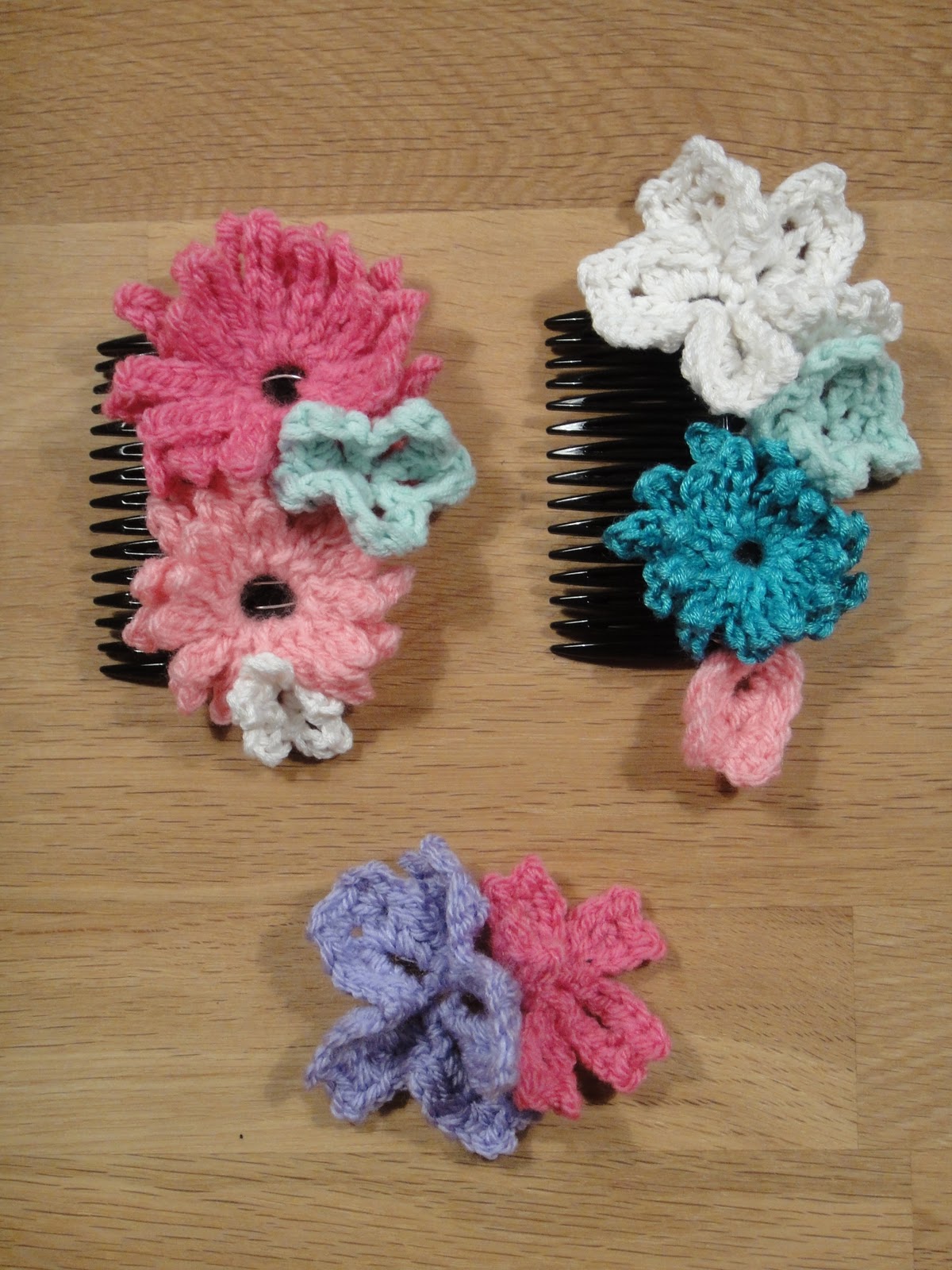
Finally, this weekend I made some haircombs with a few of the crochet flowers I made previously. They're meant to be a kind of mix up of the current English fashion for crochet flowers and the traditional Japanese fabric flower decorations that went with kimono. I'm really pleased with how vibrant they look in small groups! I'd wanted to see what it would be like to make a matching accessory to go with the teapot cover I'd already made, and start building up a kind of range. Being relatively quick and easy to make, they won't cost so much, so hopefully I can sell several to people not wanting to spend big amounts of money. I'm not too sure about the combs, as though they're traditional Japanese hair accessories, I don't think many people necessarily know how to wear them as they're not very common here (I couldn't figure out how to get them to sit in my hair either). So, I'm also looking at hair elastics and pins as well, so people can use them as corsages. A lot of people wear crochet flowers on hats at the moment. These combs I'll probably donate to the third year undergraduates to raise money to take them to New Designers in London, and see how people react to them at the sale. 


Anyway, I guess that's everything up until now! Until next time :)


Saturday, 21 January 2012

Hyper Japan


Doki Japanese TablewareI have just discovered that the big Japanese culture event I'm planning to go to in February is going to have Japanese ceramics there too! I can't wait!

http://hyperjapan.co.uk/2012-spring/culture/580-doki.html

The event is called Hyper Japan, and I found its website online a few days ago. I thought it was pretty unusual, as I've only ever seen museum exhibitions of traditional stuff or comic/anime expos being organised before, nothing really about the rest of the Japanese culture. However, here they seem to have everything all mixed up together! Food, sake, kimono, cosplay, street fashion, books, films, manga, music, traditional crafts......

So maybe the overall effect is something like this:


:P

However, I could never hope to do such an extravaganza of sensory overload justice with a few mere photographs. J-culture has to be seen to be believed.

I've been on some of the exhibitors websites now, and among other things, they have some gorgeous kanzaki, or hair ornaments. I've been thinking for a little while it might be nice to have a go at making a hair comb or pin the the crochet flowers I'm making. Crochet corsages are pretty popular here at the moment, and giving them an oriental twist might spice them up a bit! >: 3

Matching teapot and hair accessory anyone?

Tsumami-Kanzashi /kz61Rose hair comb - purple


For those interested, this is Hyper Japan's website: http://hyperjapan.co.uk/ , and it's on for three days, the 24th, 25th and 26th February at Earl's Court in London