Hello again!
A fair bit has happened over the past few days, so I'll try and start at the beginning.

Well, I've been busy trying to investigate new teapot designs and decoration since I came back from Japan in October (but more about that in a later post). There was so much amazing stuff out there, and I spent two weeks surrounded by ceramic artists from all over the world, so I've gone on a bit of a tangent since I returned so that I can try out all the things I saw. One of the things that stuck in my mind the most was watching Magdalene Odundo work. I learnt about her in my first year of university when we were taught about smoke firing and burnishing pots, and it always struck me that despite using the coiling method, her pots always looked perfectly symmetrical and round, as if they'd been cast or something. When I actually saw her working, it was nothing like that!!! Her clay was just as rough surfaced and lumpy as everyone elses. What she does, is smooth and shape the surface once the pot has stiffened by paddling it with a piece of wood, before she finishes by polishing the piece with tumbled pebbles.
 |
| Magdalene Odundo making a coil pot at the ISCAEE conference at Tokyo Gedai University |
She uses this paddling method a lot. While we were doing a group project out there, she showed our group how if you made an enclosed bubble, you could then pat it into shape to your hearts content, knowing the air pressure inside would stop the pot collapsing. Chris Archer (lecturer at an American University) was doing this too, but with thrown bubbles. I guess the fact that we were making bricks for the project also inspired me, as my latest teapots I'm making are square, using this technique.
 |
| My spiral brick in the wall made in the group project |
 |
| The wall under construction and completed :) |

I've already made one small teapot this way, and the last few days I've been trying to construct another, larger one. It feels very much like trying to shape a partially deflated football! On the plus side, I can cut the lid straight from the teapot body for a perfect fit. However, one thing I have discovered is that it is not easy to make a big enclosed thrown shape, and that they do not like to be tall shapes. So, thus far, the teapots have been very unlike my usual style and are short and squat! Size and shape will have to be worked on next.
 |
| My first square teapot |
...
After that I did some more work on the computer aided design software we're meant to be learning. It had all started out so well, with me playing around with the features and getting some cool looking simple objects, so I was excited to have another go this week. I thought, why not create a mould or two I could use to make batches to sell? Then I remembered that I have in fact hated CAD software since college :P
This time, I tried to make a teapot on the screen, but this being unfamiliar "solidworks" software, and not "prodesktop", I don't know how to use it, and failed when trying to trim the excess spout that appeared on the inside of the pot. Most frustrating. Why don't they make it possible to create new sketches on one plane like sensible people (wait, am I actually calling prodesktop sensible?)? That way I could make a separate cutting profile to mirror the profile of the inside of the pot. Leastways, it has now annoyed me to the extent that I won't let it go till it obeys me! Next plan of campaign: don't try and rotate a hollow profile for the pot, rotate a solid profile, and shell the entire solid teapot afterwards. I will not be defeated by a computer!
...
By Friday, I had Japanese class and we were taught some new kanji (characters adopted from the Chinese language). To my amusement and delight, the kanji character meaning craft, is also the same as the katakana (the japanese writing system used for foreign words) character used at the start of my name. Art is officially a part of my identity!
 |
| My name in Japanese is Emirii. That character shaped like a capital I at the top is the katakana for E, and the kanji for craft. |
It makes me wonder if there are lots of cases like this? I know that some kanji characters are built from other smaller ones, but are there lots of double entendres in the Japanese language? Sensei pointed out that the character for cheap is a roof over a woman. If you keep your wife at home, then she won't be on a shopping spree!
 |
| The kanji meaning cheap |
It would be interesting to find out if I can build something creative around this idea.
...
After Japanese class, I got back, and finally got the email I'd been waiting for. Okuda Tomoko san, a potter from Tokoname in Japan, had written to update me on what was happening. I met her at Hatfield Art in Clay, and she offered to let me go and be her assistant for a few months in Japan. However, there had been a problem and it was no longer certain I would be able to go. Thankfully for everyone involved, it turns out that everything should be ok, and the situation should be able to be resolved very soon (I really hope so!). This means I can book the plane tickets! I can't wait.
 |
Traditional Japanese oribe glaze on a bowl made by
Tomoko san. It is a copper glaze and has a beautiful
subtle crazed luster all across its surface.
|
Tomoko san makes light shades and oribe pieces (you can see some of them here:
http://www.artinaction.org.uk/artist-630/Tomoko-Okuda), and has her own shop in Tokoname, a famous pottery town near Nagoya. I would be helping her in her studio, mixing clay and whatever she needed, and in return she is going to teach me about Japanese pottery techniques. This is going to be the most amazing work and cultural experience ever! She has been saying that her mother will enjoy talking to me because I can speak Japanese (so I've been studying hard!) and that she will show me some Japanese life as well. I am hoping to arrive in time to see the hanami, the cherry blossom viewing festival. It is a concept utterly alien in England, yet such a famous and huge event in Japan, going out to see the flowers and celebrate their beauty under the trees with a big party! I think that despite the big futuristic cities, they still live in a greater harmony with nature than Westerners do.

I don't know much about Tokoname yet, but it's very old, and there seems to be a great scope of different styles of pottery there, unlike other pottery towns I've heard of, such as Bizen. I haven't yet been able to find out what Tokoname's trademark is (Bizen's is to wrap rice straw around the pots and fire it incredibly high, giving a kind of red streaked, incredibly hard pottery). As well as Tomoko's work, I love some of the teapots I've seen being produced there. Some have gorgeous patterns painted up the side, like this momiji (maple leaf) design by Houji, similar to what I want to achieve. You can see a bit of the variety here at
http://www.yuuki-cha.com/japanese-teapots?zenid=4bcb03e3c9b4060d45459ec1fdca1515 .

I think one reason why I want to learn Japanese pottery is the natural effects they achieve in the clay. There is such a depth of texture and colour that the pieces look incredibly tactile, and the pieces have a kind of understated grace and elegance. It's hard to explain how it makes me feel exactly, but peaceful, happy, and strangely at home definitely comes into it. If I think about it too much, there is almost a bittersweet melancholy to it, as if they remind me there is something precious I have lost.
...
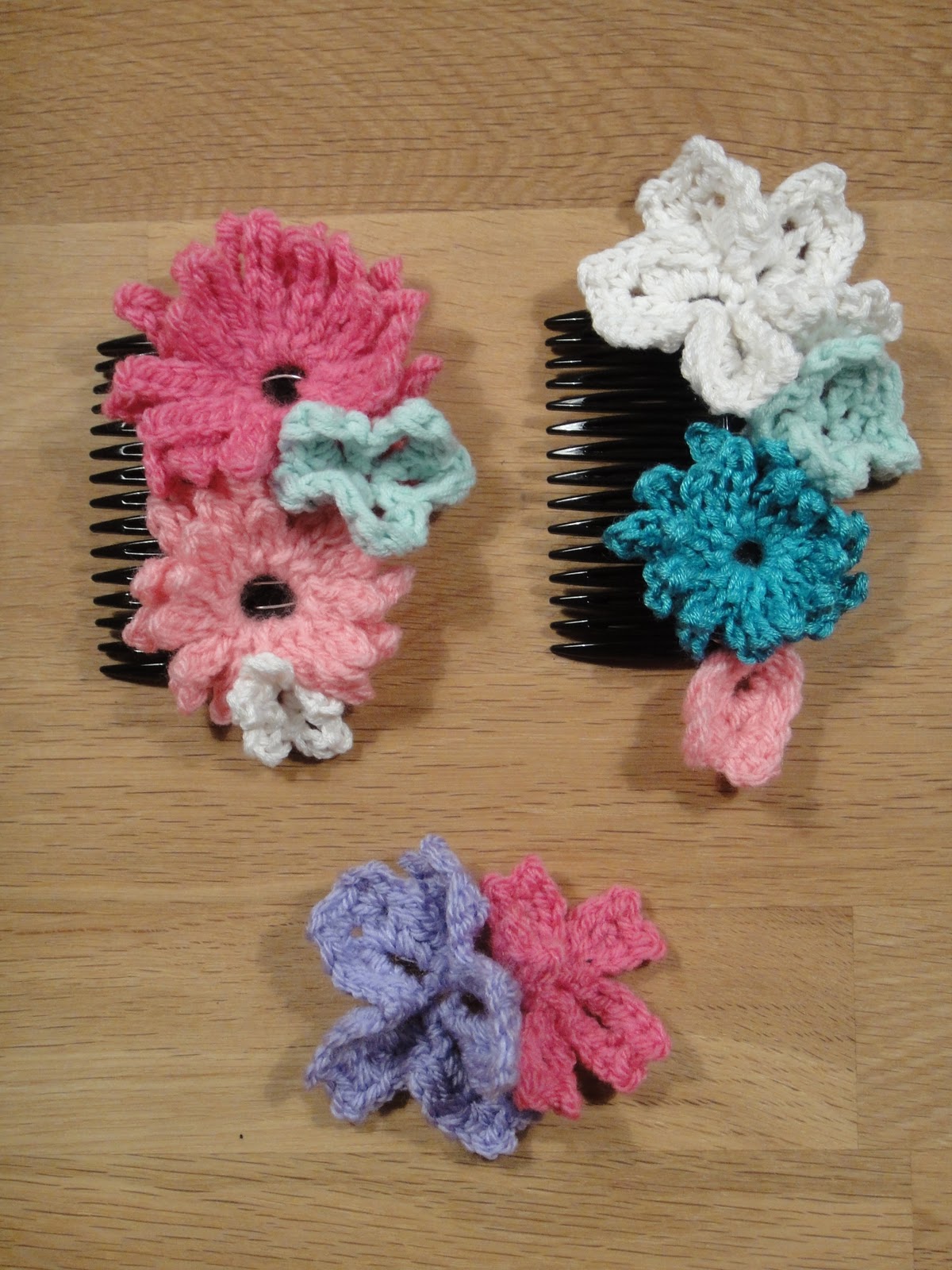
Finally, this weekend I made some haircombs with a few of the crochet flowers I made previously. They're meant to be a kind of mix up of the current English fashion for crochet flowers and the traditional Japanese fabric flower decorations that went with kimono. I'm really pleased with how vibrant they look in small groups! I'd wanted to see what it would be like to make a matching accessory to go with the teapot cover I'd already made, and start building up a kind of range. Being relatively quick and easy to make, they won't cost so much, so hopefully I can sell several to people not wanting to spend big amounts of money. I'm not too sure about the combs, as though they're traditional Japanese hair accessories, I don't think many people necessarily know how to wear them as they're not very common here (I couldn't figure out how to get them to sit in my hair either). So, I'm also looking at hair elastics and pins as well, so people can use them as corsages. A lot of people wear crochet flowers on hats at the moment. These combs I'll probably donate to the third year undergraduates to raise money to take them to New Designers in London, and see how people react to them at the sale.


Anyway, I guess that's everything up until now! Until next time :)