Thursday, 26 April 2012

Diary 12/04/12

(early)


I woke up just before 6 A.M. today with the light seeping through my curtains. I went into the courtyard and the morning light was so beautiful, I went and got my camera and took some pictures. There’s a sakura tree just outside Tomoko’s studio, and the light was filtering through all the petals.
     
After that, I went and waited for Tomoko sat by the kotatsu with my crochet. After a while I heard her alarm go off, and then a bit later she came down. She told me that she’d called me yesterday at 7 P.M. but I was too fast asleep! We had breakfast (baguette and banana for me, baguette and yoghurt for Tomoko) and we chatted again, half in English half in Japanese. It turns out Tomoko loves Disney, and has a few Disney themed bits and bobs around her living room. She’s been to Disneyland in Tokyo and Orlando too, and asked if the European one was popular in Europe too. She also asked if I like Studio Ghibli, the Japanese animation house similar to Disney.

Then we got talking about Japanese tea, after I put the water into the teapot too hot (oops). Tokoname is famous for it’s teapots as the clay here is very good for brewing tea in, so there is a lot of expertise here. Tomoko showed me two of her little teapots, called kyushu. Her favourite one is very tiny and incredibly thin, and she picked it up and sat it on the end of its handle to show me the balance. It looked exactly like something Allen would do with his ceramics, find some precarious and delicate way of standing a piece just because he could! Both teapots had been thrown in quite a dark clay, and the bigger one had a kind of impressed pattern which looked like it was made with a saw blade halfway up the side, and a metal mesh for a sieve instead of pierced clay. The lid rested on an inner gallery, and had no tab to hold it in, the Japanese place a hand over the lid when they pour. They also use side handles. Tomoko said she’d try and arrange for the artist of her favourite teapot to show me how he makes his teapots. I can’t wait! As she called him, he truly is a master to make such delicate and well balanced pots.

She’d given me a wheel thrown porcelain cup to drink out of, and I noticed it was very translucent, so I told her it was much better than English porcelain, which surprised her a lot. Apparently there are a lot of porcelain recipes here, some specifically for translucency, and many artists make lights with it. These artists are famous for being scrupulously clean to prevent iron contamination! Tomoko said she was too messy to work with it and never uses it, and I told her I work with red clay and porcelain. She then taught me that I was saying it wrong – terracotta is aka tsuchi, not aka do. The kanji for earth has more than one pronunciation, and I’d got the wrong one! She showed me the writing and a couple more words in Japanese. Apparently a clay mixer (I think ball mill) is do ren ki – dorenki. I told her I wanted to compile a glossary of ceramic words, so I could maybe make some kind of Japanese to English ceramic dictionary, and she showed me a book by Penny Simpson, Lucy Kitto and Kanji Sodeoka called “The Japanese Pottery handbook”. It’s amazing, it has everything in there, information and translation, even for all the chemical names. She has leant it to me, so I can study up! However, suddenly my idea seems a bit beside the point, Penny has done something similar already, but more comprehensive. I’ll probably still do it though, as Penny’s book is a text book, and the words are not in alphabetical order, so it will be useful to have a reference where it is easy to look words up.


After that, she told me next weekend will be a Spring festival in Tokoname, with traditional artforms on display she is going to take me too. There will also be one just for crafts later in April, so we will yoyo between her gallery and the rest of the festival. Today, after she has done her laundry and everything, she’s going to take me on a tour of Tokoname. I can’t wait!

Tomoko’s gallery, studio and home from the footpath


(late)


Brain overload! Tokoname has a lot of galleries, and a ceramic mall, and we went around a lot. I saw a lot of very beautiful nerikomi, an interesting mix of marbled clay and a technique similar to Sasha Wardell’s. I really want to find out the name of the artist making those pieces. Tomoko told me that a layer of iron was painted over the marbled clay and then scooped away to reveal ovals of veined colour. There were a few artists I thought I recognised, and a lot I didn’t. One chawan had an amazing lustre glaze on similar to Miyazaki Miyamura, but I’m pretty sure Tomoko said the artist was called Murasaki. She didn’t recognise Miyamura’s name. The glaze was very crystalline , but the crystals were crowded and not obvious from a distance. It didn’t seem to be high fired either, but the clay body was white. I also saw the National Treasure, Yamada, everywhere in special display cabinets with photos of the artist. There were some amazing glazes too, many with jun effects, and even a couple of pale pink ones. Of course, there was a lot of oribe! There was also plenty of white engobes, one artist using sgraffito in it, which I really liked. Her plates and bowls were very simple white with a dun clay underneath, and flowers or vegetables drawn in. Another favourite was an artist who appeared to be using porcelain, or a very pure white clay, and left rough torn edges all over the surface so metal oxides could be rubbed in. The pieces I saw used copper, but some used silver which tarnished to multicoloured hues over six years. What really struck me was how skilled the Japanese are at using composition, form, line and texture simply to produce the best effect, and how much they used the qualities of the clay to create beautiful pieces. It made English ceramics look very contrived. A lot of the pieces had no glaze at all, and were just the fired clay surface, or the glaze was poured or splashed over sections, or created by ash in the firing. It made me seriously question my practice to date. I spend too much of my time fighting my medium. Most of the galleries didn’t allow photographs (but you can pick the ceramics up and handle them). So, I plan to go back later with more time and a sketchbook!

After the galleries, we got lunch (udon noodles – I didn’t mange to politely slurp mine, as they were busy burning my lips) and later a café for tea. I had a matcha set (sweet first, then matcha and a small cup of sencha to finish), and it was far more bitter than I remembered. Apparently this café is well populated by local potters, so Tomoko said I should hang out there and try to get to know them. If I talk to them about ceramics, they might show me their work shop, or tell me their techniques. She’s friends with the owner (and has her on order for four thousand guinomi – unbelievable. Who needs that many sake cups?!) who does pottery for a hobby. The sweet (made from rice and shaped like a – maybe a sakura or camellia) was served on a stand made by her. It was utterly beautiful with the sweet on. It looked just like a slab of flat rock, except it had feet and marks from the wadding it stood on in the anagama. The rock effect was caused by the rough edge. She ripped the clay when it was leather hard. Everyone was very friendly, and Tomoko got me to introduce myself to them in Japanese. They seemed to enjoy my clumsy attempts, and one lady was fascinated by my hands – first she noticed they were soft for a potter (it was a very sunny day and the heat does that to them), then that they were big compared to hers. English women are big compared to Japanese ladies, who are for the most part pretty tiny! Apart from the ceramics, Tomoko showed me where the supermarket and train station is, as well as tell me other basics. We also saw a glass workshop (again, using the glasses natural characteristics to create the pieces – they were very fluid looking, some with bubbles in, some thick, many not perfectly round).

This evening she laid out the ground rules about work, my curfew, and how to behave. She’s teaching me Japanese manners and how to eat like the Japanese. I must respect my elders and let them go first (including being served in a café and taking a bath), I mustn’t say “Mmmm” because it sounds like “Unnnnn” which means no in Japan, and when eating from a big plate, put a hand under the food like an “osara” (plate) when transferring it to your mouth. As for work, I get two days off per week, and time to make my own work, which I can sell in her gallery for 50% commission, because she’s paying for the clay! Soon it will be Golden Week in Japan, so there will be many visitors and we need affordable work to sell to them. I’m looking forward to getting back to making! She’ll show me how to use her workshop tomorrow. She gets up at about 7:30 A.M.


P.S.

Internet is semi there, I can use Tomoko’s pc, but the keyboard is difficult (it keeps switching to hiragana script) and the browsers don’t trust any of the websites I need to use. Google chrome lets me on facebook under protest, and internet explorer lets me on blogger and gmail under protest. Ironic! Neither will let me on hotmail.

This is an old soda kiln that was used to fire pipes. It’s huge! The wooden tub is the mould used for the pipes. All the walls were running with glaze and ravaged by the heat.


Brick sculpture/wall in a shopping centre. Areas of it are ash glazed. 

Diary entry 11/04/12 - Arrival

11/04/12


I woke up at about 10 P.M. and found no sign of Tomoko. I think she must have already gone to bed. It’s been a strange day, but not a bad one. The last few days have been pretty hectic really.

I was still busy at uni on the 30th of March with the last of my Japanese exams (the written one) and by that time I was pretty tired. This left me just over a week to sort out my flat, sleep off my deadlines, pack and get ready to go to Japan for two months. My to do list was pretty extensive. I’d already redirected the post and got a working holiday visa (I had to visit the Japanese embassy with an application and various documents, and they then took my passport off to add the visa), undertaken a course in Japanese language, looked at phone rentals, researched the best flight options (Tokyo Narita airport taxes are insanely expensive, so I flew via Frankfurt), and a number of other things. Now I had to clean and tidy and shut up the flat, do the garden, pack, check all my electronics and digital storage, check I’d got everything I needed or go and buy it (my canvas shoes were pretty well worn out and had to be replaced), sort out lines of communication I could use, including for data transfer, and check what medication was allowed (I have hayfever, and some over the counter English medicines are illegal In Japan, with nasty consequences) etc, etc. It’s all kind of blurred in my head now.

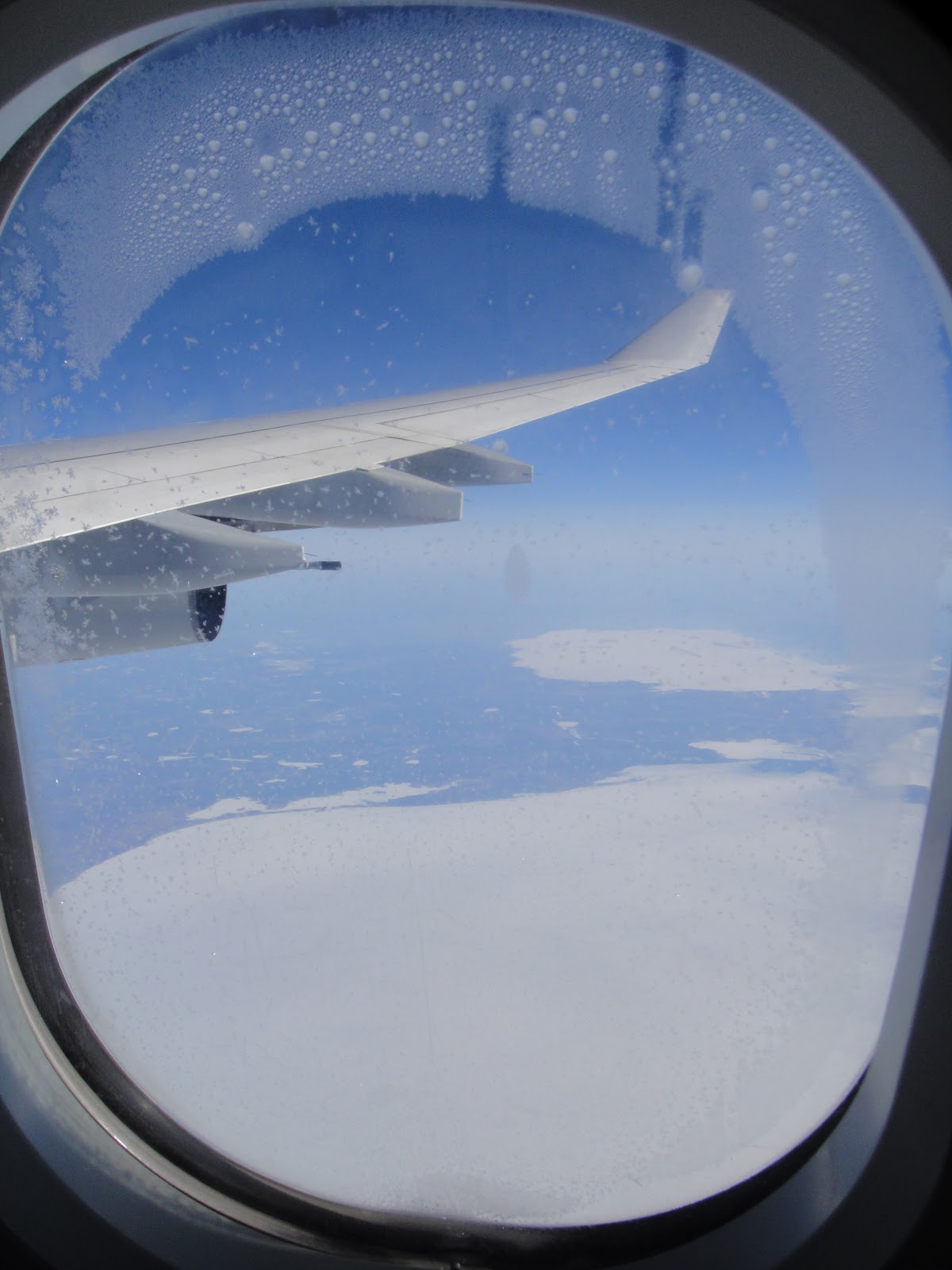
I was nervous coming to an almost complete strangers house in a country where I’m only just learning the language, but I thought I’d be more so. Monday night my parents took me to the airport hotel in Birmingham, and I spent a lot of time after they’d gone to bed doing a last minute copy of a large amount of my Japanese notes with my camera. We got up at 6 A.M., had breakfast and then headed over to the terminal so I could check in. I’d cut my baggage down pretty ruthlessly so I’d be within the weight limits, and I wasn’t carrying any books that weren’t Japanese phrasebooks or sketchbooks, only roughly enough clothes to last a week, a few pairs of shoes and my laptop. Not to mention various toiletries, as last time I came to Japan, one of the people I was with accidentally bought floor wipes thinking they were face wipes. Not a mistake I want to make! Check in went fine, and soon I was at the security gate saying goodbye. The flight to Frankfurt was short and I slept for most of it. There was a small amount of turbulence at the end, and then the plane taxi-ing to the terminal felt longer than the flight. Once off that plane, I had to catch the next flight to Nagoya after some lunch. To my surprise, the airhostesses spoke English, so it was a pretty easy flight, but next to impossible to sleep. The flight path took us north and through Russian airspace, over part of Siberia and over North Mongolia, China, then Korea.


During the flight I had to fill out two immigration forms to hand in at customs, asking the purpose of my visit and whether I was carrying restricted or illegal items.


I’d done this last time I flew to Japan so was expecting it, but I did wonder what category the hayfever tablets fell into all the same. In the end I left that section blank.

Eventually we came in to land, and for a minute I thought we would land in the water. All I could see was ocean underneath us until right at the last minute. Then we were down, and I saw a sign saying “CHUBU CENTRAIR” and then one saying “STOP” painted on the ground. So much for the language barrier, I swear everywhere speaks more English than their mother tongue….

Going through customs went ok in the end. Once I found the right counter, they decided piriton would be permissible, and I managed to hold a conversation with the customs people in Japanese. Getting out the other side, I rearranged my luggage and put the passport away while keeping an eye out for Tomoko. I couldn’t properly remember what she looked like having met her only once, I had an impression in my head of a small older lady who wore glasses. The lady who caught my eye was not wearing glasses, and looked taller and younger than I remembered.

She came over and then we went out to her car, which was bigger and less boxy than most Japanese cars, and she drove me a short distance back to her house in Tokoname. The area we drove through reminded me very much of the back streets in Tokyo, but with fewer buildings. There was the odd concrete block, and then streets of tiny dark wooden houses with bamboo screens over the windows and greenery by the door. Tomoko asked how long I’d been learning Japanese and told me it had been really sunny the day before despite today’s rain, and that because of a long cold winter, the sakura had only just come out so I’d truly be able to see the Japanese spring.

Then we got to her house. Tokoname has a pottery path, a kind of trail for visitors to take with a lot of galleries and sights to do with the ceramics industry on it, lined with old houses and walls made of old pots, and she lives next to it. It’s old, and looked very small and cute. She told me it’s rented, and there are two parts or wings to it. The toilet is separate again, in a small bit by itself, and had a western style seat over a hole in the floor – no flush. The room she has given me to use is traditional Japanese in the opposite wing to where she sleeps, and seems to be used for guests and storage (bags of different clay are stacked by the front door), with a separate front door. The walls are made of some kind of chipboard with gold sparkly flecks in it that catch the light, it is eight tatami mats big and has a futon, low chest of drawers and dressing table in it, plus a floor cushion and a couple of her sculptures. Simple but quite cosy. Her studio is semi outdoors, it’s kind of a semi courtyard and is a covered area between the toilet, two front doors and her garden. There were shelves of half made pots, her kiln and other kit. Her Mum and herself live in the other wing, where the living area, shop, kitchen and bathroom are. The bathroom is tiny and is the usual showerhead and stool next to the deep bath, with a separate basin area through a curtain off the kitchen. The lounge has a kotatsu in. I’d never seen one before! They are low tables with thick blankets under the table top hanging down to the floor, and they have a heater underneath for keeping your legs warm.

Tomoko introduced me to her Mum and we chatted for a bit (she asked where I lived, and told me that English potters Penny Simpson and her friend Ruth had been visiting the previous week as well), before Tomoko said she had to take her Mum to the hospital for an appointment, but would be back at about 2 P.M. and we’d have lunch. Since then I unpacked my bag, had a shower and slept until now. We’ll see what happens tomorrow. Tomoko won’t be working, but I’m going to try and get up at 8 A.M. as I don’t know what her usual routine is.


P.S. Thankfully, I have discovered that my phone really can call and receive in Japan. No internet yet though.


Updates

So, I`m going to attempt to upload my diary entries to blogger to keep you all up to date with what I`ve been doing. So busy!!! Wish me luck :)

Thursday, 12 April 2012

Arrival in Tokoname!

Wow, this is really something! The entire page is written in Japanese, and my kanji just isn`t that good! I`ve finally made it to Japan and am borrowing Tomoko san`s pc. I arrived yesterday and slept pretty well all day, but today Tomoko san showed me around Tokoname, the famous pottery town where she lives. I`ve decided I could spend my entire life collecting Japanese ceramics! It`s all very beautiful and very in tune with the material. She told me this place has the best clay for making tea in, so there is a lot of expertise here in making teapots and brewing tea. She showed me her favourite kyushu (small teapot) which is absolutely miniscule and very very thin. It has a side handle, and she sat the teapot on the end of it to prove what good balance it had. It gave me kittens thinking it would fall! She said she wanted to take me to meet the maker so he could show me how he works. Very excited! I have no idea how anyone could throw something so delicate and thin. There are also two festivals she wants to take me to, one this weekend to celebrate spring, and one a bit later dedicated to craft, so we`ll have to yoyo between the festival and Tomoko`s gallery so her work can take part. Oh yes, and I just saw the most ginormous soda kiln ever!!! It was used when Tokoname made a lot of clay pipes, and the walls were running with glaze and half disintegrated from all the firings. There was a mould in there that used to be used for the pipes, and it looked just like a Japanese bath. A person could very easily have crouched through the pipe it would have made. Hopefully will post pictures later :)

Thursday, 29 March 2012

More teapots, and matching cups :)


This is the final terracotta teapot of the four I made, just going into the kiln for bisque! This is the biggest of the four, and I had problems with this one due to the length of time I tried to keep it damp so I could work on it. It was harder to impress the circuit board pattern in this one (leather hard is really not ideal) and as a result of all the pressure it was put under and the amount it got sprayed, two of the feet got compression fractures and started to slump. I've tried to fix this by squeezing the clay wall back into shape and smoothing over the cracks, but I won't know if this has worked until it is fired. If it was porcelain it would certainly warp. I really hope this one survives though. The knob on the lid is a new design, it is a shallow dish/bowl form with the idea that it will work like the glaze test bowls and really show off the beautiful effects of the glaze, but again it is also inspired by Japanese roofing with the flared edge, gabling and round ended roof tiles of the pagodas. It might also double as a handy built in tea bag rest!


I've been wanting to do this for a while now. I was originally always more inspired to paint people more than  anything else, as you can paint not just the form and play of light, but more than that the essence of who that person is. This person is a modern Japanese girl. Apparently electric guitars are very popular among high school girls in Japan, and this girl had posted a video of herself on youtube playing an electric guitar while wearing a contemporary styled short kimono and face mask. Many Japanese wear the face mask to protect themselves from pollution, from catching other people's bugs or passing on a cold of their own, to try and help with hayfever, or to make a style statement. "Yankees" (bad, tough, rebellious girls and gangmembers) often wear them to look hard. A lot of Japanese girls who post videos online often cover their faces to hide their identity too. So, it kind of goes with her kimono, which usually I would suggest is wa loli style due to it's short length, but this is not cute, fluffy and girly enough for that, it's far more punky in style. This is how Japanese traditions and cultures are evolving, the geisha who once wore beautiful kimono and played shamisen to entertain at parties are now street wise school girls in customized kimono with electric guitars. The whole thing has taken on a more vibey, urban and electronic feel. I've painted her in porcelain slip using the traditional Japanese style, again with the modern screen print to give that the contemporary twist the subject herself portrays, and put the computer circuitry behind her to emphasise the cyber/electronic influence. The Japanese character to her right is "ki", meaning energy, which I think is what time might really be; the continuous flow and exchange of energy through everything, even ideas.


When I first painted her, she was a little hard to make out, so the outline needed to be emphasized. I didn't want to use slip trailing as I had on the others, as her edges were formed by inward curves, unlike on petals where they were often high points, so I scratched some detail back in through the brush strokes to add some detail without losing the feel of the brush or her form. I found that in the end the red screen print was really what brought her to life by picking out the guitar. The rest of her suddenly became much clearer at that point. The only issue left was that I got her head slightly too big, but that's the risk you take with such immediate techniques where you can't rub things out!


Close up of the circuit board.


You can see the Japanese calligraphy a little clearer here, just right of her knee. I'm really happy with this one, so I can't wait to see what it will come out like when it's fired.


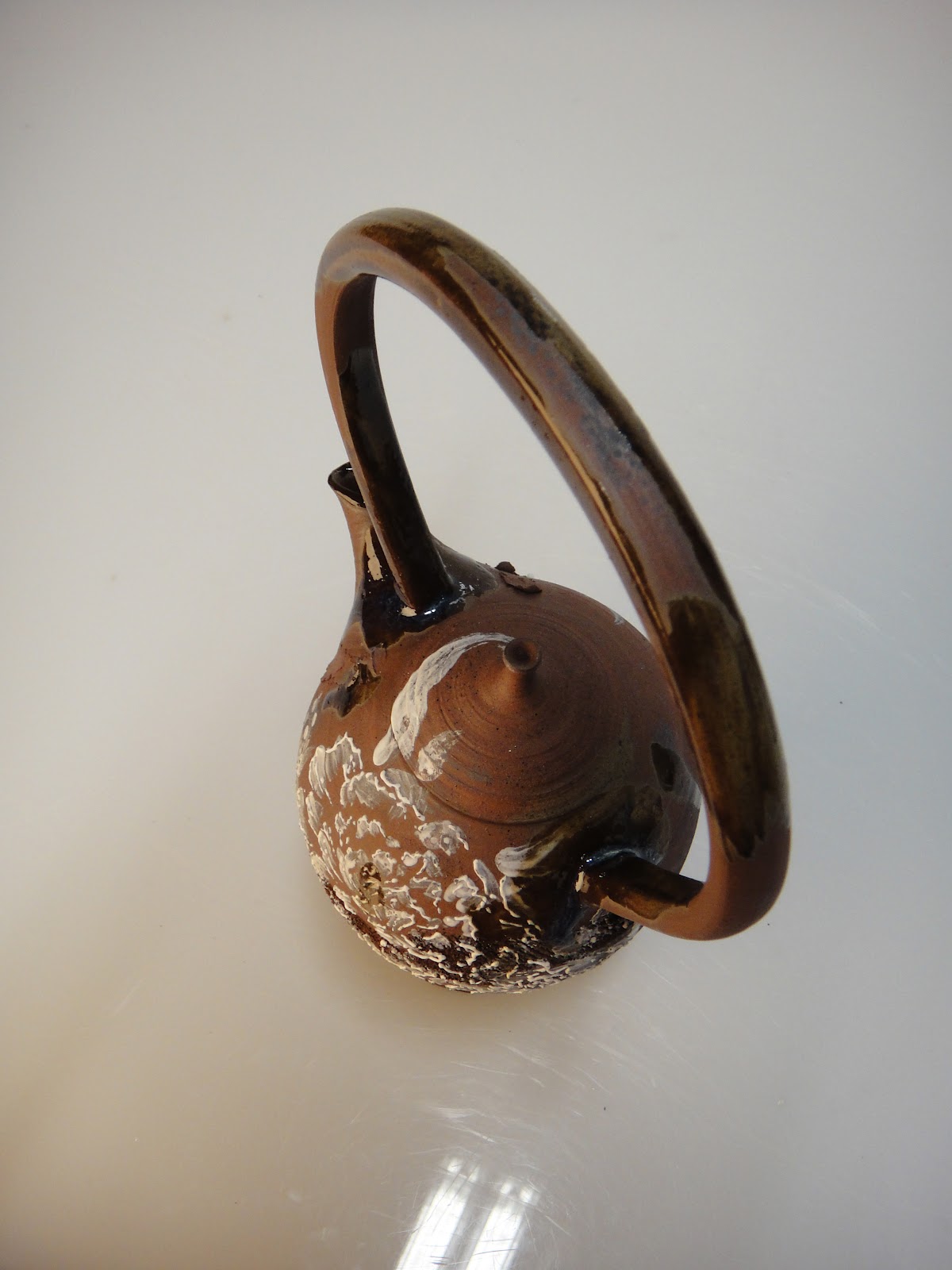
Here's the third of the terracotta teapots, and the only one that I planned out ahead of making (mostly). It is much taller and more slender in shape than the others, giving it a more elegant feel, and has a smaller rounder handle to compliment this. I left the teapot spout join unsmoothed, as I was trying to achieve a torn paper edge effect, and I had been using small bits of clay to help reinforce the cross hatching and slip and fill in any gaps, which were scraped across with a rubber tipped modelling tool and ended up looking rather torn and papery as a result. Basically, just what I was after. After discovering how to get this effect that I'd been searching for, I added it around the feet as well to match the spout. Originally, I tried to give this teapot very wide feet with only a thin shaped slit to echo the shape of the knob on the teapot, but I could not get them all even or looking any way that I was happy with, so they became like the others with tear drop shaped cut outs to refine the appearance a bit. I think that the thin slit was probably just a bad design idea. The teapots also look quite nice before the feet are cut, and are ok with a simple cut out design, but the shape I had chosen to use to make the slit just didn't look good when I tried it. At some point I'm going to make one where I leave the foot ring in tact though..


This was a continuation of the cross hatched surface idea. The first terracotta teapot had the surface slashed after I decided I liked the rough texture I made when joining pieces, so I had contrasting surfaces and a "worn" area on the pot. This time the area is defined into the shape the Japanese use to represent water in the landscape. The design on the top is peonies at various stages of blooming (buds through to wilting). The cross hatching and the peonies are what was planned on paper so that they interacted well compositionally (also, I couldn't decide what would look best anyway!). The shape of the peonies are particularly suited to being portrayed in brush strokes, so it's come out really well, but needed defining with the slip trailing just to define the form clearly. This has given it a really good delicate feel, and the slip trailing has managed to stay put on the terracotta too. I tried to make this design wrap around more of the surface of the pot after people commented about the teapots being very one sided and not considering the other surfaces, to see how the effect changed. I like the design overlapping the lid, and I think it is an improvement that the design wraps around more, as it is now interacting more with the form. The curving composition of the flowers really suits the form.


However, I decided it still needed another flower on the back just to complete the design and not leave huge  empty spaces. I added the character "ai", meaning love, as in manga I often see floating peonies used symbolically in romantic scenes where we would use floating roses.


There was a slight issue with this pot unfortunately. I still can't remove the lid as the fit is so tight. Another time I will know better and sand the hole before I fire it and it jams. So far, I have tried swivelling the lid in an effort to wear the hole down, had sand poured in the gap in order to sand it down more (unfortunately this just jammed it further) and tapped the lid with some wood to try and loosen it. I'll keep trying anyway.


I added only sparse splashes of glaze to this one so they were just accessorising the design and not interacting with it too much. The glaze creates fantastic lines across the surface where it runs, and also really improves the feel of the handle where I covered the grip. In this case, less is definitely more. 


Glaze and print on the handle.


Close up showing the translucent brush marks and slip trailing detail.


Going back to the Wedgwood Museum teapot I made previously, I made two matching cups. At first I couldn't decide whether to leave them plain to allow the teapot imagery to stand out, or whether to create matching surfaces. In the end I went for the matching surfaces to emphasize the main piece. I decided not to add the huge footrings on these that I use for my porcelain cups, as they were not needed to counteract a runny glaze, and I took the opportunity to try the different shape. I also decided against feet as the height would have looked wrong on such a tiny vessel compared to the teapot.


The new ocean deep glaze layered over the new dark gold coloured glaze (still needs a name - any suggestions?), the same as with the bowl I did previously, but this time on one of my teapots. I didn't get the glazes on as thickly as I would have liked, so there is a really thin patch at the back and less gold shimmer than I would have liked. The teal is also much paler. However, the combination of glazes works really well together, and the dark gold prevents the runny flambe from running off the pot. This solves the problem of the shape at the bottom of the pot being obscured or ruined :) Next step - try with the other flambes and develop more colours from the same base glaze.


The handle has warped much less on this teapot (it has only bowed further, which I anticipated) but this is a rarity. I need to learn to control the warping or change the handle design, because I cannot continue to only produce what can be only considered "seconds". There are a few options I can try: I can add molochite to the porcelain body that I use for pulling handles to act as a fine grog to create a kind of infrastructure, or I could create terracotta teapots and coat them in a thin layer of porcelain slip. I already dry the porcelain handles to just beyond leather hard in the handle shape before joining, moving them as little as possible after pulling, and then ensure that they go on perfectly upright so that there are no slight bends that can develop further, and that the centre of gravity in each handle is directly over the join. However, with the reliability of the terracotta, I can now start to investigate more complex handle shapes as I don't have to compensate for warping or a degree of failures in the kiln. Handles that failed before may now work.


The original plan with this teapot was to create a cover to compliment the glazes. It doesn't currently have one, but I do intend to investigate more covered pots. After the previous one, I still want to try crochet flowers on a plain fabric ground to allow the flowers to stand out.


This teapot has been glazed with ocean deep again, but this time the firing did not include a cooling ramp, so the bubbles have not been allowed to escape and the surface has a foamed up texture.


The handle has warped more than I anticipated and gained almost two corners. I'm not too keen on it now, but it will probably grow on me with time as the others that have warped have. What I really can't accept is how the glaze has run over the base and obscured the cut outs and detailing there, but this would be better if the glaze had been soaked longer and not foamed. Firing it again now would just make the running worse however. This kind of base doesn't work well with my flambé glazes at any rate, but I could use a technique similar to the one above to fix this.


The group of terracotta teapots. I love grouping them together, as variety is the spice of life, and they set each other off through the slight variations in form.

Monday, 26 March 2012

Finished teapots


This is the first of my new terracotta range, with cross hatched areas to create rough textured areas, brush painted chrystanthemums and screen print in oxides and underglaze turquoise with glaze splashed over the top. I'm really happy with these, as finally I have teapots that aren't always warping in the kiln! I also really love the dramatic dark colour. I had thought that maybe the porcelain would crack or flake in places due to the different shrinkage rates, creating an interesting weathered effect, but it hasn't at all. Instead it has adhered admirably to the terracotta and taken on the characteristic translucency of porcelain, giving the brush painting even more depth and a slightly ethereal almost not there appearance. So, even though it didn't do what I thought, it still gained an aged appearance like I wanted! This also opens the door to the possibility of putting other imagery underneath the slip painting for extra imagery layering. I also really love the interaction of the glaze as well, adding extra texture and a more ergonomic grip to the handle, as well as a splash of colour. I think I prefer glazing this way, I can be more creative with it and not worry about masses of molten glaze running off the pot and potentially ruining the base. As for the feet, of the two teapots I've got out of the kiln, the feet look best with one at the side, not two as the shape flows better, but also with the cut outs as this makes them look less heavy. I have been trying to give the teapots a light and "lifted" appearance (or rather I have been avoiding slouching and bad posture?) so that people will want to lift them and use them as they look like they are reaching for the air already. It just feels right somehow.


Here is the teapot for the Wedgwood Museum. The slip trailing has also managed to glue itself to the terracotta really well, and makes a lovely contrast with the opaque dark clay. The translucency really lends itself to the wings, and I love the circuit board pattern underneath. I'm trying to express the journey tea has taken from ancient China and Japan to the modern day in England, often sat in a mug in front of the computer screen. So, we have a Japanese inspired brush painting of a Japanese butterfly (kuro ageha for anyone interested) contrasted with the circuitry and modern print of today's Western world. I hope whoever buys this will treasure it.


Sunday, 25 March 2012

Midnight Ocean Bowl


Japanese tea bowl that we were served green tea
in at a little Japanese restaurant. I just about
managed to tell the guy serving that Allen
really liked his collection of ceramics :)
This was really just a very nice test piece to start off with, because I wanted to see the interaction between the new Ocean Deep and dark gold semi crystalline glazes, thinking they'd look good together if they were chemically compatible, but I love the result and this bowl has been shown interest already. It has gained me another commission only hours after leaving the kiln. I'm starting to think that my work is going to be split in two, work to show off my glazes, and work to show off print and surface decoration. The idea for overlapping glazes is taken from Japanese tea ware and also various potters who exhibit at Hatfield art in clay, such as Wendy Lawrence, and the results are usually stunning due to the complex interplay of chemicals, creating unique effects and creating fantastic variations of colour, texture and pattern. The appearance is also usually more organic and natural looking, so the work gives off a very free and relaxed vibe. The only issue with this bowl is I'm utterly unconvinced about its functionality. Allen Richards (my research partner) tells me the dark gold glaze is food safe, but I'm not convinced, as it's almost in oxide overload (the finish is metallic after all, and metals can leach out into food if there isn't enough silica to pin them down), contains copper (which makes leaching even worse) and manganese (which is a bit poisonous to be honest). Allen reckons manganese is only dangerous in oxide form though (he may be right there but I'd have no idea), that the glaze won't leach as the oxides haven't completely overloaded yet, and finally, that my concerns about the fact that the surface of the glaze is easily scratched, and so is not very hard wearing and won't stand up to acid in food are unfounded. Either way, I think I won't be happy until the dark gold glaze has been acid tested for food safety.